LMS data residency: can your data stay in the UAE or Qatar?
Can LMS data stay in the UAE or Qatar? Yes, if your cloud provider has a region there. See which providers do, what else counts and what to ask.

Balanita team Analysts, developers and support engineers
Published
9 min read
Yes, if your cloud provider has a region there. At Balanita, your LMS runs in a cloud account you own, so you choose the provider and the region, including regions where we have never operated. We manage the server. We do not own it, so where the data sits is your decision, made at scoping.
Data residency has a short answer and a long list of conditions. The short answer is yes. The conditions decide whether that answer holds for you.
This post covers the conditions: which providers have regions in the UAE or Qatar, what counts as LMS data besides the server, what a single region does not protect you from and what we cannot tell you. It is not legal advice.
It builds on who owns each part of an LMS when someone else builds it, because residency follows ownership: the account that holds the server decides where the data sits.
What does data residency mean for an LMS?
Data residency means the physical location where your data is stored. For an LMS, that is the server holding your database of learners, enrolments and completion records, plus the course files and backups. It is a separate question from who can access the data, and from which laws apply to it.
Three questions get mixed up, so keep them apart:
Swipe sideways to see every column.
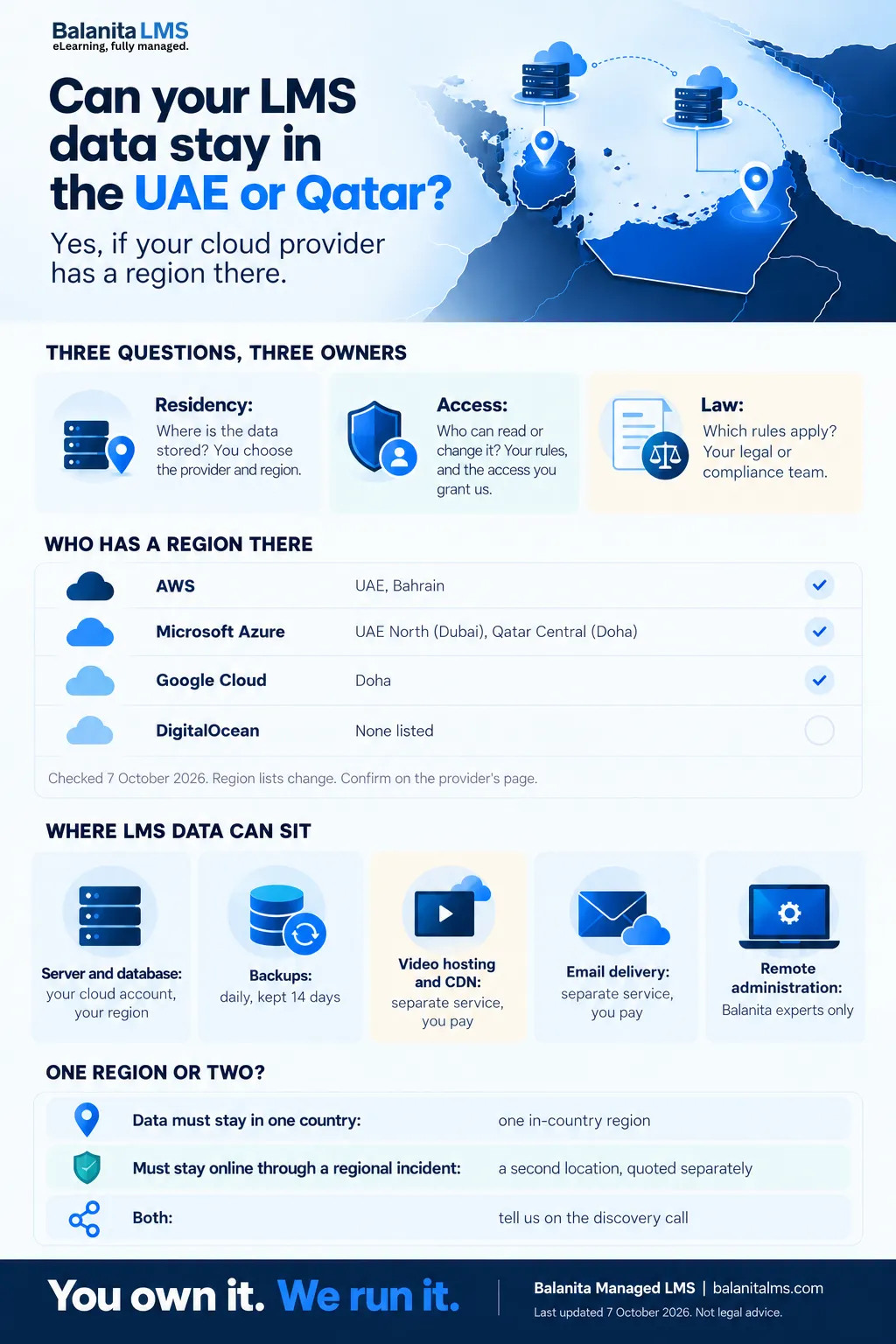
| Question | What it asks | Who answers it |
|---|---|---|
| Residency | In which country or region is the data stored? | You, by choosing the cloud provider and region. |
| Access | Who can read or change the data, and from where? | Your access rules, and the access you grant us. |
| Law | Which rules apply to this data and this organisation? | Your legal or compliance team. |
This post is mostly about the first row. It touches the second. It leaves the third to the people qualified to answer it.
Which cloud providers have regions in the UAE or Qatar?
Several major providers do. AWS, Microsoft Azure and Google Cloud list regions in the UAE, Qatar or both. Not every provider does: DigitalOcean’s availability page lists no UAE or Qatar data centre. Your provider decides your options, so the provider choice and the region choice are one decision.
Swipe sideways to see every column.
| Provider | Regions in the UAE, Qatar or Bahrain | Source |
|---|---|---|
| AWS | Middle East (UAE), API name me-central-1, and Middle East (Bahrain) | AWS News Blog (opens in a new tab) |
| Microsoft Azure | UAE North (Dubai) and Qatar Central (Doha). UAE Central (Abu Dhabi) is marked as access restricted to specific customer scenarios, so confirm access with Microsoft before planning around it. | Microsoft Learn (opens in a new tab) |
| Google Cloud | Doha, Qatar (me-central1) | Google Cloud documentation (opens in a new tab) |
| DigitalOcean | None listed in the UAE, Qatar or Bahrain. The page was last verified by DigitalOcean on 1 October 2026. | DigitalOcean documentation (opens in a new tab) |
Last checked on 7 October 2026. Region lists change, and a region can exist without every service being available in it. Confirm on the provider’s live page before you decide.
Balanita’s own scope names AWS, Microsoft Azure, Google Cloud and DigitalOcean as examples of providers whose accounts we manage, plus another provider if your policy requires one. The table shows why the choice matters. If your rule says the data stays in Qatar, a provider with no Qatar region is not an option, however good it is for other reasons.
What counts as LMS data besides the server?
Residency covers more than the live server. Backups, external video hosting, content delivery networks and email delivery services can each store or move data. Balanita configures and verifies your daily backups, and the third-party services are separate subscriptions that you pay for directly. Ask where each one sits before you sign.
Swipe sideways to see every column.
| Part of the LMS | How it works at Balanita | What to ask |
|---|---|---|
| Live server and database | Runs in your cloud account, in the region you choose. | Which provider and which region? |
| Backups | Daily, automated, covering site files and database. Configured and verified by Balanita. Kept for 14 days. | Where are backups stored, and does that match the server’s region? |
| External video hosting and content delivery networks | Separate subscriptions, paid by you directly. On Enterprise builds, large media is delivered through one of them. | Which locations does the service use? |
| Email delivery services | A separate subscription, paid by you directly. Enterprise builds set up a dedicated service for bulk notifications. | Where does it process and store messages? |
| Remote administration | Balanita’s own experts manage the server remotely. Server access is limited to them. | From where do they connect, and do your rules treat remote access as well as storage? |
One fact belongs in plain sight. Balanita is a Sri Lanka-based company, and our team manages client servers remotely from there. The data stays in the region you chose. The people who patch, monitor and support the server work from Sri Lanka. If your rules cover access as well as storage, tell us at the start. We scope the work around your rules, or we tell you we cannot meet them.
Does keeping data in-country protect you from an outage?
No. A region is a place, and places have incidents. Keeping data in one in-country region ties your availability to that region. Provider regions in the Gulf have reported service impairments in 2026. Balanita does not guarantee infrastructure uptime, and standby servers or multi-region failover are quoted separately.
Here is one documented example. From March 2026, a status page published by MongoDB reported, citing AWS, power and connectivity issues that significantly impaired two availability zones in the AWS UAE region and also affected the Bahrain region. The status page is here (opens in a new tab). We cite it as a reason to ask about failover. It is not a verdict on any provider. Every large cloud provider has had incidents somewhere.
The trade is real, and it is yours to make. A second location in another region may break your data rule. A single location may break your availability target. Neither answer is free.
Swipe sideways to see every column.
| If this matters most | What it points to |
|---|---|
| Data must stay in one country | One in-country region. Accept that availability depends on that region and its availability zones. |
| Training must stay online through a regional incident | A second location. Standby servers or multi-region failover, quoted separately, and checked against your data rule first. |
| Both, with no compromise | Tell us on the discovery call. It changes the scope and the price, and we say so before you commit. |
The uptime of the underlying server and network belongs to your cloud provider, under its own service level agreement, or to your own team if you use your own servers. We commit to patching, monitoring, backups and response times within your support window.
How does Balanita confirm your region?
We confirm the provider and region at scoping, before the build. You tell us your IT policy, your cloud provider and any location rule. We then size and secure the server for that region. If you use your own servers instead, they sit wherever you put them.
Here is the sequence on a Balanita Server Management engagement:
- Discovery call. We ask whether your IT policy fixes the server location or the cloud provider.
- Requirements summary. Your hosting constraints go into the written summary, and you approve it before the build starts.
- Provider and region. Confirmed at scoping, before the build.
- Your cloud account. You hold the account and its payment method. Balanita receives the access it needs to manage the server.
- Sizing. We size the server from your expected active learners and your peak users online at the same time.
- Domain access. We need access to your domain’s DNS settings, so we can point your site at the server.
- Go-live. Server Management fees start at go-live.
What does it cost?
Balanita’s Server Management fee follows your active learner band: US$ 150 a month up to 500 active learners and US$ 300 a month for 501 to 1,500. Larger bands are quoted. The cloud bill is separate, paid by you to your provider, and cloud prices differ by region, so ask your provider for the figure in the region you choose.
Prices are in US dollars and exclude taxes. An active learner is anyone who logs in at least once in the billing month. Annual prepayment gives 12 months for the price of 10. Balanita does not mark up or resell the cloud bill. Standby servers and multi-region failover are not part of the standard service and are quoted separately after we review your scope. The Balanita pricing page has the full list.
What can Balanita not tell you about data residency?
We cannot tell you which rules apply to your organisation. Whether a regulator, a client contract or your own IT policy requires data to stay in the UAE or Qatar is a question for your legal or compliance team. We can set up and manage the server in any region your provider offers.
That line matters, so we keep it sharp. We do not interpret data protection law. We do not claim that any region satisfies a specific regulation. We do not host servers in any country ourselves. What we do is narrow and checkable: the server runs in your account, in the region you pick, and we patch it, monitor it and back it up.
What should you bring to a discovery call?
Bring your IT policy and any written rule about where data may sit. On the free 30-minute call we ask which cloud provider you use, where the server has to be and who signs off the project, and we tell you honestly if we are not the right fit. No platform is named on the call. Your exact first-year cost is confirmed in writing before any payment.
Frequently asked questions
Can my LMS data stay in the UAE or Qatar?
Yes, if your cloud provider has a region there. The server runs in a cloud account you own, so you choose the provider and the region. Microsoft Azure lists UAE North in Dubai and Qatar Central in Doha, and Google Cloud lists a Doha region. Check your provider's live region list before you commit, because region lists change.
Does Balanita host my LMS in the UAE or Qatar?
No. Balanita does not own, host or resell servers. Your LMS runs on infrastructure you own, usually a cloud account in the region you choose. We manage the server under Server Management. In-country hosting is therefore your choice, made with your provider, not a Balanita data centre.
Where are my LMS backups stored?
Balanita configures and verifies daily backups of your site files and database, kept for 14 days. Backup location is something to confirm in writing at scoping, so it matches the region you chose for the server. Ask the same question of any provider you compare us with.
Can Balanita staff access my server from outside the UAE or Qatar?
Balanita's own experts manage the server remotely, and server access is limited to them. Our team works from Sri Lanka. If your rules treat remote access as well as storage, tell us at the discovery call, so we can scope the work around them.

Written by
Balanita team
Balanita's analysts, developers and support engineers choose, build and run learning platforms for corporate and professional training teams.
Balanita on LinkedIn