How to choose an LMS: outcome first, platform second
Choosing the platform before the outcome is the costliest mistake in a training rollout. Here is the order that works and what to decide first.

Aneslin Bala Founder and CEO, Balanita
Published
8 min read
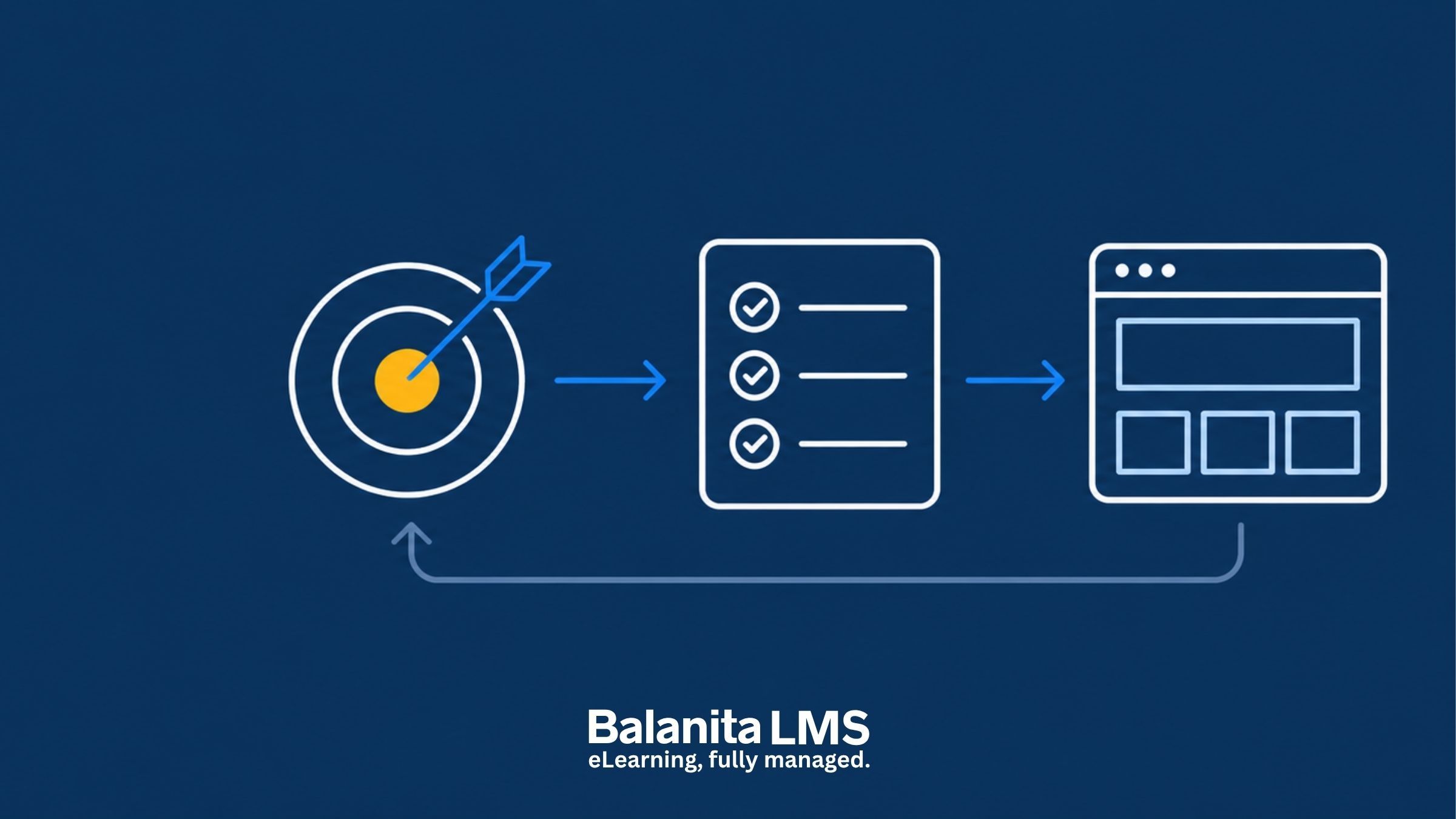
Fourteen years in eLearning, and the most expensive mistake I still see is the order of decisions. Buyers choose the platform first and define the outcome later, if at all. The platform then limits what they can build and sets the price of changing their minds. Define the outcome first. Then choose the platform that delivers it.
Most buyers who contact us ask the same first question. What does it cost? They have already decided that their current platform is bad and that a different one will fix it. Only the price is left to settle.
A new platform on its own does not deliver an outcome nobody defined. It delivers a new platform.
This post covers the order that works, what it costs to get the order wrong and what to decide before you look at a single feature list. It is my opinion, and it includes a part where we got it wrong ourselves. If the term managed LMS is new to you, start with what a managed LMS is and what the provider does each month.
What does choosing the platform first look like?
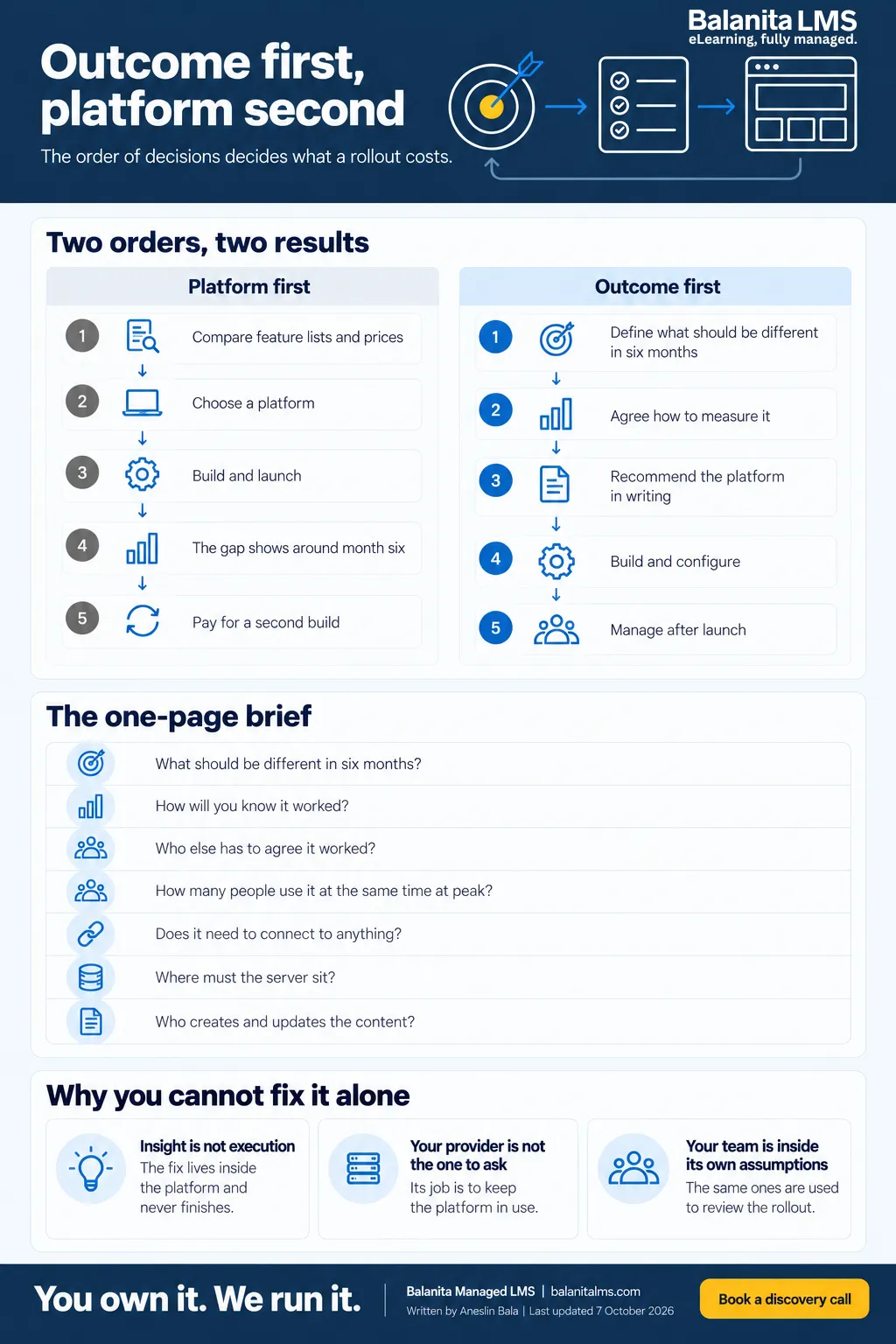
It looks like a buyer comparing feature lists and prices before saying what training must achieve. The question is which platform is best. The better question is what should change in six months, and how you would know. Without that answer, every platform looks like a reasonable choice, and none can be proved wrong.
Swipe sideways to see every column.
| Platform first | Outcome first | |
|---|---|---|
| First question | Which platform is best, and what does it cost? | What should be different in six months? |
| What gets decided first | Features and price | The outcome, and how to measure it |
| How success is judged | Whether the platform went live | Whether the agreed measure moved |
| What a change costs | Often a second build | Usually a change inside the platform |
| When the gap shows | Around month six | Before the build, in the requirements summary |
When a buyer asks the price first, we give it. Honestly, and straight away. The build starts at US$ 4,000 and goes up with scope. Monthly management starts at US$ 450 a month for up to 500 active learners. Then we ask one question back: what made you start looking? A number tells you nothing on its own. The price follows the scope, and the scope follows what you are trying to fix.
Why is it the most expensive mistake?
Because the cost of a wrong platform does not show up at launch. It shows up around month six, as a course that breaks or a team that works around the system. By then the licences and the build are paid for, and the training time is gone. Switching means paying for a second build.
Month six is when the gap between the outcome and the platform shows. Completion is low. Or the reports cannot answer the question the business is asking. Or managers cannot see their own teams. By then you have loaded courses and enrolled learners, and each one makes a change harder.
Here is what the second build costs on our own rate card. A major rebuild is scoped as a new Balanita Launch project. Launch starts at US$ 4,000 for up to 500 learners and US$ 8,500 for up to 2,000. Enterprise starts from US$ 15,000, quoted by scope. Licences are separate and paid in your name. Your cost depends on who does the rebuild, so treat these as our figures, not an industry average. They also exclude the first build, and the months of training that did not happen.
And that is the part nobody budgets for.
What did we get wrong about this ourselves?
We used to say LMS failures are a strategy problem, not a technology problem. It cost us leads. Buyers heard the word strategy and took it to mean free thinking they could do themselves. Several concluded they could fix their own situation with better ideas, and they did not buy. The line argued them out of the purchase.
They were half right. The thinking is free. The work is not.
We found this in real lead conversations, not in a planning meeting. So we changed the line. The new one never uses the word strategy. It says eLearning fails when the expected outcome was never paired with the platform choice, the configuration and how it gets managed after launch. That pairing is the work.
Why can’t you fix this yourself, or ask your current provider?
You can fix part of it yourself. You can define the outcome. The harder parts are three: the fix lives inside the platform and never finishes, your current provider has no reason to say the platform was the wrong starting point, and your own team cannot easily see the assumptions it built the rollout on.
Insight is not execution. The fix lives inside the platform: how courses are sequenced, how roles and reporting are set up, what changes month to month as the team learns what works. That is ongoing technical work. It does not end with a good idea in a meeting.
Your current provider is not the one to ask. Its job is to keep the platform in use. Saying the outcome should have been defined before the software was chosen is not part of that job. That is not a criticism. It is a description of the job.
And your team built the rollout inside its own assumptions. The assumptions that caused the failure are the same ones being used to review it. An outside view is the only one that is not already inside them.
What should you decide before you choose a platform?
Decide what should be different in six months, how you will measure it, who has to agree it worked and how many people will use the system at the same time at peak. Write it down in a page. Any platform recommendation that does not start from that page is a guess.
Here is the page. We ask these on every discovery call:
Swipe sideways to see every column.
| Question | Why it matters |
|---|---|
| 1. What should be different in six months? | It defines the outcome. A vague answer here is the real problem. |
| 2. How will you know it worked? | It gives you a measure, such as completion, or repeat errors on one workflow step. |
| 3. Who else has to agree it worked? | It names the sign-off before the build, not after. |
| 4. How many people will use it, and how many at the same time at peak? | It sizes the build and the server. |
| 5. Does it need to connect to anything? | An HR system, an identity provider or a CRM changes the scope. |
| 6. Where must the server sit? | Your IT policy may fix the cloud provider or the region. |
| 7. Who creates the content, and who keeps it current? | A platform with nothing loaded on it does not train anyone. |
After the call we write a requirements summary within 3 business days. You approve it. Only then do we recommend a platform, in writing, with every plugin, theme and tool and its licence cost shown. You approve that too, before the build starts. You buy every licence in your own name. We name no platform on the first call. That is deliberate.
What if you have already chosen a platform?
Then test the choice against the outcome you should have defined first. Write the six-month outcome, the measure and the peak users. If the platform meets all three, keep it and move on. If not, find out now, before the build, because the price of changing rises with every course you load.
Sometimes the platform you chose is fine. We say so when it is. If you already run a platform, we audit it for free before Balanita Manage takes over the monthly running. The audit checks configuration, security, plugin health and existing learner data. If it meets our standard, the monthly service starts the following month. If it needs fixing, we scope and quote that first. If we are not the right fit, we tell you on the call.
What happens on a discovery call?
The free 30-minute call starts with what you are trying to fix, and what should be different in six months. We name no platform. If we are not the right fit, we say so on the call. If we are, the written requirements summary follows within 3 business days, and the platform recommendation comes after you approve it.
Frequently asked questions
Should you choose the LMS platform before defining the outcome?
No. The outcome decides which platform fits. Define what should be different in six months and how you will measure it first. A platform chosen before that answer can be a reasonable product and still the wrong fit, and you only find out after the build.
What should you decide before choosing an LMS?
Decide what should be different in six months, how you will measure it, who else has to agree it worked and how many people will use it at the same time at peak. Add whether it must connect to other systems, where the server must sit and who will keep the content current.
How does Balanita choose a platform?
We start with a discovery call, then send a written requirements summary within 3 business days. You approve it. We then recommend one platform in writing, explain why it fits and show every plugin, theme and tool with its licence cost. You approve that before the build starts. We name no platform before discovery.
Can I keep the platform I already have?
Yes, if it passes our audit. We audit an existing platform for free before taking it over. The audit checks configuration, security, plugin health and existing learner data. If it meets our standard, the monthly service starts the following month. If it does not, we scope and quote the fix before we proceed.

Written by
Aneslin Bala
Founder and CEO at Balanita. Leads strategy and client engagements at Balanita, which he founded in 2012.
Aneslin Bala on LinkedIn